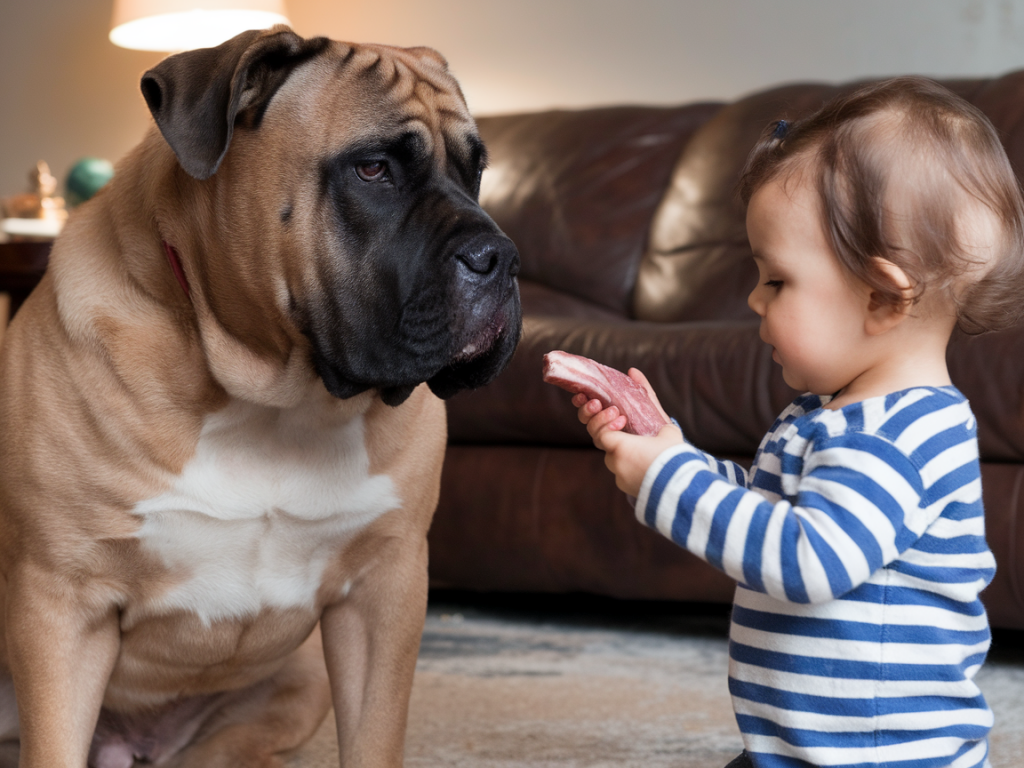
I’ve worked with Bullmastiffs my whole life, and I’ve seen the tension that can build at mealtimes when big, food-driven dogs live with curious children. Resource guarding — when a dog growls, stiffens, or protects food or toys — is frightening for families and often misunderstood. The good news is that, with patience, predictable management and positive conditioning, you can teach both dogs and children to share space safely around food without confrontation or punishment.
What resource guarding really is (and what it isn’t)
Resource guarding is a natural, evolutionary behavior: dogs have learned to protect items that are valuable to them. But guarding becomes a household problem when it creates safety risks for children. It’s important to remember that guarding is a communication tool — not defiance. Responding with punishment or confrontation usually makes the behavior worse by increasing anxiety.
First steps: safety and management (before you start training)
Before any behavior-change work, make the environment predictable and safe. Management is the foundation that prevents incidents while you re-train the dog’s emotional response to children near food.
Change emotions, not just behavior: counterconditioning and desensitization
Our goal is to change how a dog feels when a child is near food — from anxiety or threat to “good things happen.” This requires two linked strategies: counterconditioning (pairing the child’s approach with positive outcomes) and desensitization (gradually increasing the child’s proximity).
Here’s an approach I use, adapted for a home with children:
Train reliable cues that keep everyone safe
Teaching children and dogs predictable cues reduces confusion and anxiety. A few that I find most useful:
Teach children what to do (and what not to do)
Kids are part of the solution. They need clear, age-appropriate rules and supervised practice:
Using food to build trust: hand-feeding and trade-up games
Hand-feeding is a powerful tool when done safely. Feeding small portions by hand at times when the dog is relaxed — not during tense guarding episodes — communicates that people are the source of food and good things. Start with soft, small bits and stop if the dog shows stress.
Trade-up games teach the dog that giving up food or toys yields something better. For example:
When the problem is more than training
Some cases of guarding are rooted in anxiety or medical issues (poor body condition, pain, cognitive decline). If a dog’s guarding is severe, unpredictable, or getting worse, consult your veterinarian first to rule out health causes. Then work with a qualified force-free professional — a certified applied animal behaviorist or force-free trainer experienced with large breeds and children.
Practical kit and product suggestions
There are simple products that help implement management and training:
Patience is essential. Bullmastiffs are smart, loyal dogs, and they respond well to calm, consistent teaching. When we change the way the dog feels about children near their food — pairing approach with better outcomes, giving clear signals, and managing risk — we build long-term safety without confrontation or punishment. Keep interactions predictable, reward calm behavior, and involve your children in gentle, supervised training. Over time, mealtimes will become a peaceful routine where everyone knows the rules and feels secure.