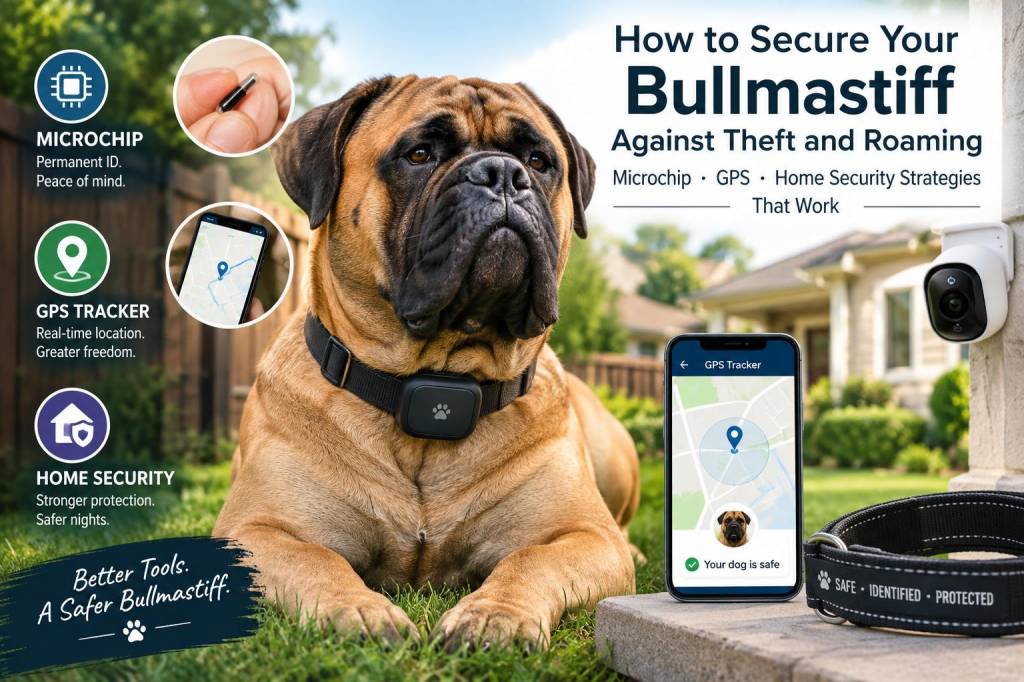
I’ve spent decades living with Bullmastiffs, and one thing I’ve learned the hard way is that a powerful, curious dog is also a dog that can wander, get stolen, or be lured away. Protecting your bullmastiff isn’t just about keeping them physically safe at home — it’s about creating layers of security so a single slip or a determined thief doesn’t turn into a tragic loss. Below I share the strategies I use and recommend: microchipping, GPS tracking, and practical home-security measures that actually work with this breed’s size and temperament.
Why layered protection matters
There’s no single perfect solution. A microchip helps reunite you if your dog is taken to a vet or a shelter, but it does nothing if someone steals your dog and moves it far away. A GPS collar gives real-time location, but batteries die or collars can be removed. Home security cuts down on opportunistic theft, but a determined thief could still breach a fence. By combining methods — preventive behavior training, permanent ID, active tracking and robust home security — you stack the odds back in your favour.
Microchipping: the non-negotiable first step
I insist every puppy I raise goes home with a microchip, and I won’t recommend otherwise. Microchips are low-cost, permanent, and frequently scanned by shelters and veterinary clinics.
What I always check and advise:
Use an ISO-compliant 15-digit microchip (this is standard in the UK and Europe).Register your contact details with more than one database. In the UK, register with the microchip manufacturer’s database and a national register such as Petlog or Datadog. Keep details updated when you move or change phone numbers.Make sure the microchip implant report is in your paperwork and that the microchip number is printed on vaccination and health documents.Periodically request a scan during routine vet visits to ensure the chip is readable and hasn’t migrated.GPS and tracking solutions: what I fit and why
For active tracking I use a two-layer approach: a robust GPS tracker for live location and a secondary Bluetooth tag for very short-range recovery. For Bullmastiffs, choose devices designed for large breeds — small, flimsy units can be chewed, lost or uncomfortable.
Devices I’ve used with success:
Tractive GPS — reliable real-time location, geofencing alerts and good battery life. Subscription required.Fi Smart Collar — premium build, designed for active dogs, excellent app and escape alerts.Apple AirTag / Tile as secondary short-range recovery tools — not a replacement for GPS but useful if the dog is found nearby and someone has a compatible phone.Practical tips when using trackers:
Choose a GPS unit with a dedicated, durable collar or attach method — never tape a tracker to a standard collar.Keep a spare charged tracker in your kit for walks or shows.Set up geofences for your property and favourite walk routes; get instant alerts if your dog crosses them.Check battery daily before long outings; many devices have low-battery notifications but don’t rely solely on them.Consider a tracker with offline mode or last-known location if the dog goes into an area with poor mobile coverage.Home security adapted for Bullmastiffs
Because Bullmastiffs are large and can be powerful if agitated, your home security needs to be sturdy and respectful of a dog’s well-being. I focus on making theft difficult without creating a stressful environment for the dog.
Key home measures I use:
Secure fencing: Solid 6-foot fencing, ideally with an inward-leaning top or capping to deter climbing. Avoid chain-link at ground level where they can dig under — bury concrete gravel boards or create a buried barrier.Gates and locks: Use padlocked or keyed gate latches mounted high — thieves often look for easy, low-level openings. Replace domestic garden latches with commercial-grade hardware if you’ve had concerns.Covered kennels and reinforced doors: If your dog is kept outside for periods, use a reinforced kennel with lockable door. For crate-trained dogs left in the house, use a secure crate bolted to flooring if you must leave them unattended for long stretches.Lighting and visibility: Motion-activated lights make opportunistic thefts riskier. CCTV cameras with night vision are a deterrent and provide evidence if an incident occurs.Signage and neighbours: Signs saying premises are under video surveillance can deter theft. Build a local network — let neighbours know your dog is valuable and ask them to report unfamiliar people or vehicles.Behavior and routine: the often-overlooked protection
Training and predictable routines drastically reduce risks. A dog that’s confident and responsive is less likely to slip gates, follow distracting strangers, or be lured away.
Practical behaviours to train:
Reliable recall: Train a recall that works under distraction. Start in low-distraction areas and practice with high-value rewards. For Bullmastiffs, food and strong social praise work well.Gate manners: Teach your dog to sit and wait at entrances. I always train mine to sit and only pass through a gate on command.Stranger conditioning: Expose your dog to calm, supervised interactions with new people so they’re less likely to react unpredictably around visitors.Emergency responses: Practice “stay” and “place” commands so you can quickly secure your dog when you spot someone suspicious or you need to move to safety.Practical steps if your dog goes missing
If the worst happens, move fast and methodically. My checklist when I’ve had dogs slip away:
Use your GPS tracker immediately — note the last known location and share it with friends who can assist.Contact local vets, shelters and the police with your dog’s microchip number and a recent photo.Post on community apps (Nextdoor, local Facebook groups) and national lost-pet sites. Include clear photos, distinguishing marks, and the microchip number.Walk or drive the area where the GPS last saw the dog — call calmly and use familiar cues (toy, whistle, name). Bullmastiffs often hide rather than run far.Offer a reward — but coordinate with authorities; too-large publicised rewards can encourage thefts for quick money.Documentation, visibility and prevention
Finally, keep your paperwork organised. A folder with microchip numbers, photos, veterinary records and a up-to-date description (collar colour, scars, unique markings) is invaluable. Consider putting a tag on the collar that says “Microchipped” and lists the number — this can speed up identification.
| Measure | Benefit | Limitations |
| Microchip | Permanent ID, widely scanned | Not real-time, depends on third-party scanning |
| GPS tracker | Real-time location, geofencing alerts | Battery life, removable or damaged collars |
| Home fencing & locks | Deters opportunistic theft, prevents roaming | Installation cost, determined intruders may breach |
| CCTV & lighting | Deterrence and evidence | Requires power/internet, can be tampered with |
| Training (recall, gate manners) | Reduces escape risk, improves response | Requires ongoing practice and consistency |
Keeping a Bullmastiff secure is never one-and-done. It’s an ongoing combination of technology, training and practical home security. With the right habits — up-to-date microchip registration, a robust GPS strategy, sensible fencing and daily training — you can dramatically reduce the chances of theft or roaming and be prepared to recover your dog quickly if an incident occurs.