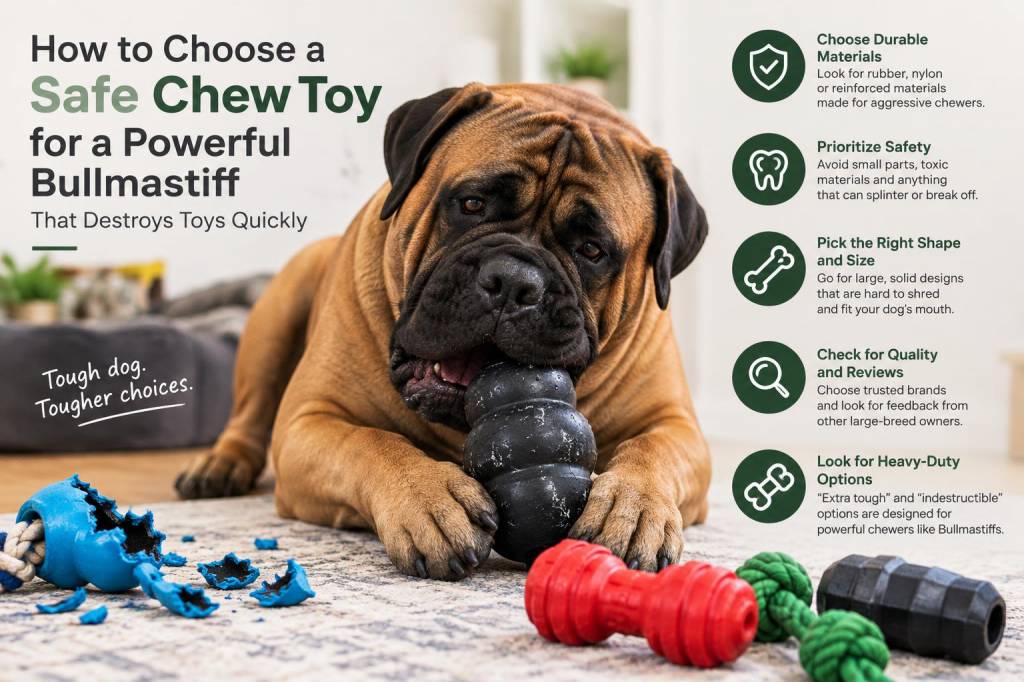
Living with a powerful Bullmastiff has taught me one thing over and over again: a chew toy is never just a chew toy. For a dog with a massive jaw, intense bite strength, and a habit of testing every object in reach, a toy has to do far more than look tough. It has to be safe, durable, appropriate for the chewing style, and still interesting enough to hold attention after the first few minutes of excitement.
When I choose chew toys for a Bullmastiff that destroys toys quickly, I do not start with marketing claims. I start with the dog in front of me. I think about mouth size, chewing force, age, energy level, and whether the dog is a relentless shredder, a heavy grinder, or a mix of both. A toy that works beautifully for one Bullmastiff may be shredded in minutes by another. That is why I pay close attention to materials, shape, and supervision rather than assuming a product is automatically safe because it is labeled “tough.”
What I look for before I buy anything
My first filter is simple: if a toy can be bitten into pieces, it is not a safe choice for a determined Bullmastiff. I want something that is strong enough to resist punctures and splits, because once a toy starts breaking down, sharp edges and swallowed fragments become real risks. I also look for enough size that the toy cannot be easily swallowed or lodged across the back of the mouth.
For a dog like mine, a toy needs to be large, solid, and designed for powerful chewing. I avoid anything with stitched seams, loose fabric, glued parts, or decorative pieces. I also avoid very thin rubber, brittle plastic, and toys that feel hollow and fragile in the hand. If I can compress a toy too easily with my fingers, I do not trust it with a Bullmastiff.
I also think about texture. Some dogs love a smooth rubber toy they can gnaw for a long time. Others prefer a firmer surface with some resistance. My own experience has shown me that a toy with the right texture can last longer because the dog is less tempted to tear at it in frustration. A toy should satisfy the chewing urge, not provoke a demolition project.
Materials that usually hold up better
In my experience, a few materials tend to perform better than others for hard chewers. No material is indestructible, but some are much safer and more realistic for a Bullmastiff who destroys toys quickly.
- Solid natural rubber: Often one of the most reliable options for strong chewers. It gives a little, which can make it more engaging, but it should still feel dense and substantial.
- Ultra-durable nylon chew toys: These can work for some dogs, especially those that like to gnaw rather than shred. I only choose versions made specifically for large power chewers.
- Heavy-duty thermoplastic rubber: A good option when the design is thick and simple, with no weak points or small parts.
- Treat-dispensing toys made for strong chewers: Useful when they are thick-walled and designed to withstand repeated use.
I am cautious with bones, antlers, and very hard materials. A toy can be durable and still be a bad idea if it is too hard for a strong dog to chew safely. Teeth can crack on extremely hard surfaces, especially when a Bullmastiff clamps down with full force. I do not want a toy that behaves like a tooth-breaking rock.
Size matters more than many owners realize
A toy that is too small is risky for obvious reasons, but a toy that is merely “medium” can also be a poor choice for a Bullmastiff. I want something big enough that the dog cannot easily get the whole object deep into the mouth or grip it in a way that encourages aggressive tearing. A larger toy also tends to be more satisfying for a giant breed because it feels appropriate to the jaw.
I usually choose toys that are clearly marketed for large or giant dogs, but I do not stop there. I check the actual shape. A long, narrow toy may be labeled for big dogs and still be easy to twist, bite, and split. A broad, thick, one-piece toy often survives longer because there are fewer weak points.
Design features I trust more than flashy extras
My Bullmastiffs have taught me that simple designs often last longer than toys covered in gimmicks. I prefer straightforward shapes with no detachable parts. A solid ring, a thick bone shape, or a dense textured block often survives better than a toy with ropes, squeakers, flaps, or attached accessories.
Squeakers are especially tricky. Some dogs love them, but many Bullmastiffs will destroy a squeaky toy quickly just to reach the sound source. Once the squeaker is exposed, the toy usually becomes unsafe. I may use squeakers only under close supervision, and I never leave them available when I am not watching.
I also pay attention to whether the toy has seams, grooves, or layered construction. Anything layered can separate. Anything sewn can tear. Anything with a weak join can fail exactly where the dog bites most often. The fewer failure points, the better.
Matching the toy to the chewing style
Not every destructive chewer destroys toys in the same way. I have seen Bullmastiffs who bite straight down with tremendous pressure, others who hold and grind, and some who like to rip and shake. A safe toy should match the style as much as the strength.
If a dog is a grinder, I look for dense rubber or durable nylon that can handle repeated pressure. If a dog is a shredder, I avoid anything with surfaces that can peel or flake. If a dog is a shaker, I steer clear of toys with weak joints or connected pieces. Understanding the chewing style helps me choose toys that last longer and fail less dangerously.
| Toy type | Usually suitable for | Main caution |
|---|---|---|
| Solid rubber chew toy | Heavy gnawing and long chewing sessions | Choose thick, one-piece construction |
| Nylon chew toy | Dogs that grind rather than shred | Check for excessive hardness and sharp wear |
| Treat-dispensing toy | Mentally active dogs that need engagement | Make sure openings are not easy to tear larger |
| Rope toy | Supervised tug play | Fraying and string ingestion risks |
What I avoid completely
There are some products I simply do not trust for a Bullmastiff that destroys toys quickly. Soft plush toys are usually out unless I am using them for a very controlled purpose and removing them at the first sign of damage. Thin ropes can unravel. Cheap vinyl toys crack. Small balls can be swallowed. Hollow plastic toys can splinter. Anything with beads, buttons, eyes, or glued-on pieces is a no for me.
I also avoid toys that advertise themselves as “indestructible.” That word makes me suspicious rather than confident. No toy is truly indestructible, and the stronger the claim, the more careful I become. I prefer brands that explain the material, the intended chewing level, and the limits of the product honestly. That tells me more than any bold slogan ever could.
Where brands can help and where they cannot
Some brands have earned my trust more than others. I have had good experiences with products from Kong, Goughnuts, West Paw, Nylabone, and Benebone, but I never buy based on brand alone. Even a respected company can make products that suit one dog and fail another. I look at specific models, not just labels.
For example, a dense rubber toy from Kong can be very useful if the size is right and the dog enjoys stuffing or treat-dispensing play. Goughnuts has some strong options for power chewers, and West Paw makes sturdy toys that can work well when matched correctly to the dog. Nylabone and Benebone can be useful for dogs that like firm chewing surfaces, though I monitor wear carefully. A product history helps, but the individual dog still decides everything.
Supervision and rotation make a real difference
One of the biggest mistakes I see is leaving a new chew toy with a powerful dog unsupervised from day one. I do not do that. I introduce any new toy during a time when I can watch closely. That lets me see whether the dog is chewing safely, trying to break pieces off, or losing interest after a few minutes. If the toy starts to fail, I remove it immediately.
I also rotate toys instead of offering everything at once. Rotation keeps interest higher and reduces overuse. A toy that is not available every day often lasts longer, and the dog treats it as something special rather than something to destroy out of boredom. This approach has saved me money and, more importantly, reduced risk.
Signs that a toy should be discarded
I do not wait for a toy to fall apart completely. If I notice deep punctures, rough edges, chunks missing, loose threads, soft spots, cracked surfaces, or any change in shape, I take the toy away. I also discard a toy if I cannot clean it properly anymore. Dirt trapped in damaged surfaces is not something I want a dog chewing on day after day.
Here are the warning signs I watch for:
- Deep bite marks that create sharp edges
- Pieces that peel, flake, or tear away
- Cracks that grow larger during use
- Loose squeakers, inserts, or inner parts
- Visible wear that changes the toy’s shape
- Any smell of mold, rot, or trapped saliva that will not wash out
My practical buying process
When I shop for a chew toy for a Bullmastiff that destroys toys quickly, I use a very simple routine. First, I read the material description carefully. Then I check the size. After that, I look for one-piece construction whenever possible. I avoid decorations and weak joints. I compare the product against my dog’s chewing style. If it passes all of those checks, I try it under supervision.
I also keep a mental record of what lasts and what fails. Over time, that has become one of the most useful tools I have. A toy that survives one dog for three months may fail another in three hours, and the only way to learn the difference is to observe closely. Every Bullmastiff teaches something new if I pay attention.
For a breed as strong and determined as this one, safety is never accidental. It comes from choosing carefully, watching closely, and accepting that a chew toy must be selected for the individual dog, not for the packaging claim. When I stay realistic about durability, honest about risk, and attentive to my dog’s habits, I can offer chewing enrichment without handing over something dangerous.