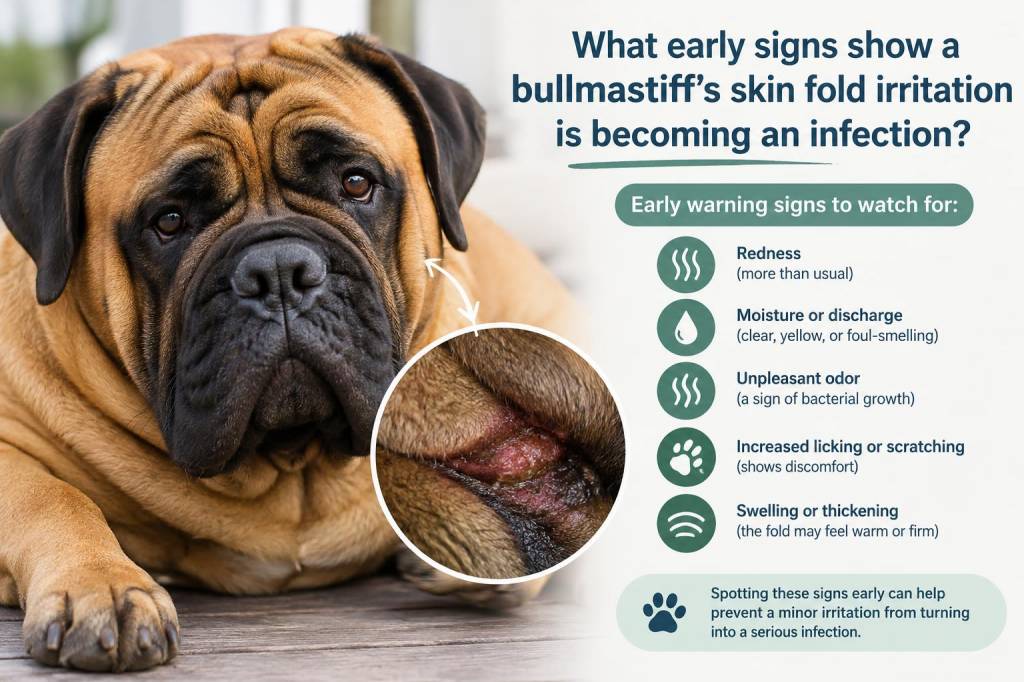
With Bullmastiffs, I pay close attention to skin folds because a small amount of trapped moisture can turn into a much bigger problem very quickly. What starts as a little redness or odor can move from simple irritation into a real infection, and once that happens, the skin can become painful, swollen, and much harder to settle. I have seen this many times in dogs with deeper facial folds, loose skin around the neck, or rub-prone areas near the lips and jowls, and the early changes are usually visible if you know what to look for.
When I inspect a Bullmastiff’s skin folds, I am looking for changes in color, smell, texture, and comfort. A fold that is healthy usually looks clean, dry, and calm. An irritated fold often becomes pink or red, slightly damp, and a little warm. Once infection begins, the skin can look angry, feel sticky, and give off a stronger odor. That odor is one of the clearest clues I rely on, because healthy skin should not smell sour, musty, or foul.
Early changes I notice before infection sets in
The earliest warning signs are often subtle. Many owners assume their dog is only a bit dirty, but I prefer to think of these signs as a message from the skin. The fold is telling us it is under stress. In my experience, the first changes often include redness along the crease, a slight moistness that does not dry out, and a dog that rubs the face, scratches near the neck, or shakes the head more than usual.
Another sign I watch for is a change in the feel of the skin. Healthy skin is smooth and pliable. Irritated skin may feel tacky, thickened, or slightly rough. If I separate the fold and see a shiny surface with a little wetness, I become more alert. If the area is tender when touched, I treat that as an even stronger signal that irritation is progressing.
Behavior matters as much as appearance. A Bullmastiff may not cry out, but I often see small behavior changes first. A dog may become restless, avoid having the face handled, or pull away when I try to clean the fold. Some dogs begin rubbing the area against furniture or the floor. That reaction often means the skin is already uncomfortable.
Signs that irritation is moving toward infection
Once infection begins, the signs usually become harder to ignore. At that stage, I look for swelling, heat, a stronger odor, discharge, and a darker or more irritated color around the fold. The skin may look wet for longer than usual, and the moisture may take on a yellow, green, or gray tint. Sometimes the edges of the fold become crusty, while the deeper area stays damp.
I also pay attention to the way the skin looks at the border of the fold. Early irritation often stays flat and pink, but infection can create raised, raw, or ulcerated patches. If I see broken skin, small scabs, or a shiny surface that seems fragile, I assume the barrier has started to fail. That is when bacteria or yeast can take hold much more easily.
Odor is especially important. A mild skin fold issue may have a faint warm smell, but an infection often has a much sharper scent. It can smell sour, yeasty, or simply offensive in a way that is hard to miss. If I notice a smell that returns quickly after cleaning, I do not dismiss it. Persistent odor usually means the skin is not just irritated; it is likely harboring microbes that are multiplying in the fold.
Another clue is recurring moisture. A fold that keeps getting damp even after I dry it carefully can be creating the perfect environment for infection. Warmth, trapped moisture, and friction work together against the skin. In Bullmastiffs, this can happen around the lips, under the neck, near the eyelids, and in other deep creases where air circulation is limited.
What infection can look like in daily life
In daily life, infection often shows up through discomfort before it becomes dramatic. A dog may drool more than usual if the lips are involved. He may paw at the face, resist eating, or hesitate to rest his head on a surface. If the neck fold is irritated, I may see repeated scratching or rubbing against a rug or couch. A Bullmastiff that usually tolerates grooming well may suddenly become sensitive during cleaning.
I have also noticed that some dogs with skin fold infection become less cheerful or less engaged. They may seem mildly withdrawn, especially if the area is sore. That change can be easy to miss because Bullmastiffs are often stoic, but a shift in attitude is worth noticing. If a dog seems less interested in normal interaction, I want to know whether skin discomfort is part of the reason.
In more advanced cases, the skin can ooze, crack, or develop a sticky coating. Hair around the fold may clump from moisture. The dog might smell unusual even shortly after a bath. These are not signs I wait on for long, because once the surface is broken, infection can spread deeper and become much more difficult to resolve without veterinary help.
What I do at home when I spot the earliest warning signs
When I see early irritation, I begin with gentle cleaning and drying. I use a soft cloth or cotton pad and a product that is safe for dogs, then I make sure the fold is completely dry. Moisture left behind can make the problem worse. If the skin is only mildly red and the dog is comfortable, this simple routine can sometimes prevent things from advancing.
I avoid strong soaps, alcohol, hydrogen peroxide, and anything that stings or strips the skin. A Bullmastiff’s folds are delicate even though the breed is powerful and sturdy. Harsh products may seem effective at first, but they can damage the skin barrier and create more trouble later.
If the irritation keeps returning, I examine the pattern. I want to know whether the fold stays damp after drinking, whether drool collects there, whether food debris is getting trapped, or whether grooming is too infrequent for that dog’s coat and facial structure. Sometimes the issue is not a one-time flare-up but a structural problem that needs regular management.
When I stop treating it as a minor issue
There are moments when I do not try to manage the problem alone. If the area is swollen, painful, discharging, bleeding, or producing a strong odor, I contact my veterinarian. I also call if the skin is not improving within a short time, or if the dog is acting unwell. Infection can spread, and in some cases it may involve yeast, bacteria, or both.
I am especially cautious if the dog develops fever, stops eating normally, becomes unusually tired, or seems generally unwell. Those signs mean the problem may be affecting more than just the surface skin. A veterinarian can determine whether the dog needs prescription treatment, a medicated wipe, an antifungal plan, or another targeted approach.
For recurring cases, I like to ask about the underlying cause. Some Bullmastiffs have naturally deep folds, some have drool-related moisture, and some develop skin problems because of allergies, weight, or anatomy. If a dog keeps getting fold irritation, I want to address the source, not only the flare-up.
Warning signs I never ignore
| Observation | What it may mean | My response |
|---|---|---|
| Persistent redness | Skin barrier stress | Clean gently and watch closely |
| Warmth and swelling | Active inflammation | Consider veterinary advice soon |
| Strong odor | Possible infection or yeast growth | Do not wait for it to improve alone |
| Moisture that keeps returning | Unfriendly environment for skin | Dry carefully and review routine |
| Discharge or crusting | Skin breakdown | Arrange veterinary assessment |
| Pain or reluctance to be touched | Significant discomfort | Take seriously and act promptly |
What I focus on during routine care
Routine care makes a big difference, and I treat it as prevention rather than cleanup. I check folds after meals, after exercise, and after any time the dog has been drooling more than usual. I keep the skin dry, but I also avoid overhandling it. Too much friction can irritate a fold just as much as too little care.
Nutrition, weight, and overall health matter too. A Bullmastiff that carries excess weight may have deeper skin folds and more moisture trapped in them. A dog with allergies may lick or scratch more, which can make irritation worse. Even the season can matter, since heat and humidity often make fold problems more common.
I also find it useful to make skin checks part of normal handling. If a dog is used to me lifting the lip, separating the fold, and checking gently, I can spot problems sooner. That habit saves time and reduces stress because I am not waiting until the skin is sore enough to make the dog defensive.
Small changes that usually deserve a closer look
- Redness that appears suddenly and does not fade quickly
- A fold that feels damp every time I check it
- Odor that comes back soon after cleaning
- Rubbing, scratching, or head shaking that was not there before
- Hair clumping from moisture around the fold
- Skin that seems tender, warm, or puffy
- Crusting, discharge, or visible raw spots
When I see a combination of these changes, I stop thinking in terms of simple irritation and start thinking in terms of infection risk. That shift matters because early action is usually much easier on the dog. With Bullmastiffs, a calm, attentive eye can catch the trouble before it becomes a painful cycle of inflammation, moisture, and worsening skin damage.
I have learned that the earliest signs are rarely dramatic. They are usually quiet clues: a little more odor, a little more redness, a little more dampness, and a little less patience from the dog when the fold is touched. Those details may seem small in the moment, but together they tell me a skin fold is no longer just irritated. It is moving toward infection, and that is the point where I take action without delay.