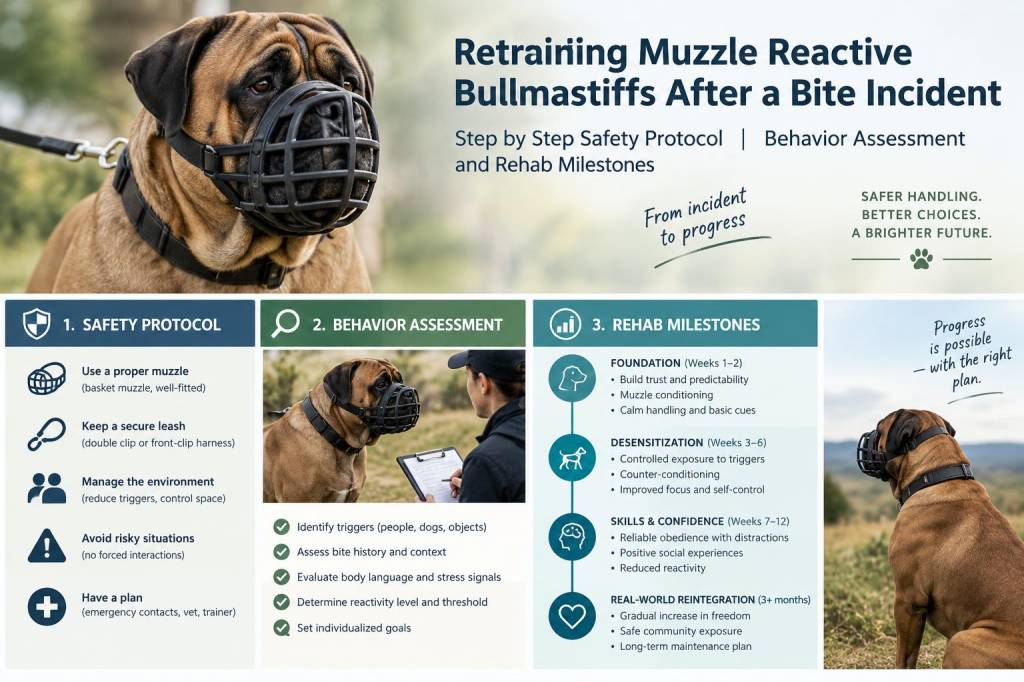
A bite incident changes everything. When a Bullmastiff bites — whether out of fear, pain, or redirected frustration — safety becomes the immediate priority and retraining becomes a careful, measured process. I’ve worked with several dogs after such events: some recovered fully, others needed lifelong management. Below I share a practical, step-by-step safety protocol, how I assess behavior, and the rehabilitation milestones I use to track progress. This is written from hands-on experience and informed by vets and certified trainers I’ve collaborated with.
Immediate safety steps after a bite
Minutes and hours after a bite are critical for safety and future rehabilitation. My first actions are always practical, calm and directed at reducing risk for everyone involved.
Secure the dog in a safe, minimal-stimulus area (a crate or a quiet room) using a familiar blanket or bed. Avoid punishment or loud reprimands — stress increases the chance of further escalation.Attend to the victim’s medical needs. Encourage them to seek immediate medical care. Document the incident objectively: who was involved, what precipitated it, and the environment.Contact your veterinarian for a medical check of the dog. Pain and medical conditions (ear infections, dental pain, osteoarthritis) are common triggers for aggression and must be ruled out or treated.Put management measures in place. I usually recommend a properly fitted Baskerville-style basket muzzle for safety during handling (not as a punishment). For transport, a sturdy crate and a second handler are wise. Don’t leave the dog unsupervised with children or unfamiliar adults.Initial behavior assessment: what I look for
A careful, structured assessment guides my rehab plan. I perform most assessments with a trusted, experienced handler and never push the dog past its comfort threshold.
History and context: What happened before the bite? Was it resource guarding, startled response, pain-related, or redirected aggression? Household routines, past trauma, and medical history are essential details.Body language baseline: I observe posture, eye contact, lip licking, yawning, freeze, stiffening, growling, and escalation sequence. I want to know the subtle signs that appear before the dog reaches threshold.Threshold testing: Using a neutral handler and low-stimulus approach, I find the distance or condition where the dog first shows discomfort. This creates a safe working distance for desensitization and counterconditioning.Reactivity triggers and intensity: I note trigger types (touch, approach, specific people, handling of food/toys) and how intense the reaction is (vocalization, snap without contact, attempted bite, completed bite).Resource guarding evaluation: If food or objects were involved, I use controlled food tests to determine guarding patterns and preferred management strategies.Developing a safety-first rehab plan
Every plan I create has three pillars: management, medical, and behavior modification. Skipping any pillar risks failure or further incidents.
Management: Eliminate opportunities for recurrence. This includes muzzling during necessary handling, baby gates to separate spaces, no free access to valued items, and clear household rules so everyone acts consistently.Medical: Address pain or discomfort promptly. If pain is ruled out yet aggression persists, I consult a veterinary behaviorist about the option of psychotropic medication to reduce anxiety and improve learning (commonly discussed drugs include fluoxetine or clomipramine, always under vet supervision).Behavior modification: My default methods are desensitization + counterconditioning, threshold management, and functional alternative behaviors. I favor positive reinforcement exclusively — rewards the dog finds highly motivating (meat-based treats, food puzzles, or a favored toy).Step-by-step retraining protocol
Below is the stepwise approach I use. Progress is dog-specific; some dogs move quickly, others need months.
Phase 0 — Stabilize and teach coping: Teach the dog simple, reliable cues at distance: look at me, sit, go to mat. Reward lavishly to rebuild trust and give the dog clear, rewarding choices.Phase 1 — Threshold work and desensitization: Work at a distance below threshold. Pair presence of the trigger (e.g., approaching hand) with high-value treats. The aim is to change the dog’s emotional response (from fear/anger to anticipation of something good).Phase 2 — Controlled approach and handling drills: Gradually reduce distance as the dog remains comfortable. Introduce short, non-threatening touches paired with immediate rewards. For handling sensitive areas, use systematic, incremental touch progressions.Phase 3 — Functional alternatives: Teach the dog to comply with a safe behavior instead of reacting — e.g., “go to mat” or “leave it” under mild provocation. Reinforce these behaviors more than the reactive ones.Phase 4 — Generalization and real-world practice: Practice with different people, environments and distractions at the dog’s pace. Use a checklist to ensure skills transfer beyond the training room.Tools and equipment I recommend
Muzzle: Baskerville Ultra or similar basket muzzles — breathable, humane and allow panting and water access.Harness and leash: Front-clip harness (e.g., Ruffwear Front Range) for better control without neck strain.Crate and gates: For safe management and predictable routines.High-value treats: Tender, smelly treats such as boiled chicken, hotdogs or freeze-dried liver to create strong counterconditioning.Professional support: Certified Applied Animal Behaviorists (CAAB), Veterinary Behaviorists (DACVB), or force-free trainers experienced with large breeds.Rehab milestones and progress tracking
I track rehabilitation with concrete, observable milestones rather than arbitrary timelines. Below is a simple table I use with owners to mark progress.
| Milestone | Criteria | Typical timeframe |
| Stability and management | Dog safely contained; household consistently following management plan | Immediate — 1 week |
| Threshold identification | Handler can reliably identify and maintain below-threshold distance | 1–2 weeks |
| Counterconditioning established | Dog consistently takes treats and shows relaxed signs below threshold | 2–6 weeks |
| Handling tolerance | Dog accepts brief, planned touches in previously sensitive areas | 4–12 weeks |
| Reliable alternative behaviors | Dog chooses "mat" or "look at me" over reacting in 8/10 controlled trials | 8–16 weeks |
| Generalization | Behaviors hold with different people/environments | 3–6 months (variable) |
When to bring in medication or a specialist
If progress stalls, fear or aggression is severe, or the dog’s welfare is declining (chronic stress, inappetence, self-injury), I involve a veterinary behaviorist. Medication is a tool to improve the dog’s ability to learn — it is not a standalone fix. Working closely with the vet and a trainer lets me combine pharmacology and behavior modification safely.
Maintaining long-term safety
Even after milestones are met, I treat safety as ongoing. Lifelong management may be needed: predictable handling routines, continued training refreshers, honest communication with household members and visitors, and always avoiding complacency. For many of the Bullmastiffs I’ve helped, the combination of careful management, positive reinforcement, and professional guidance has restored rich, safe relationships between dogs and their families.