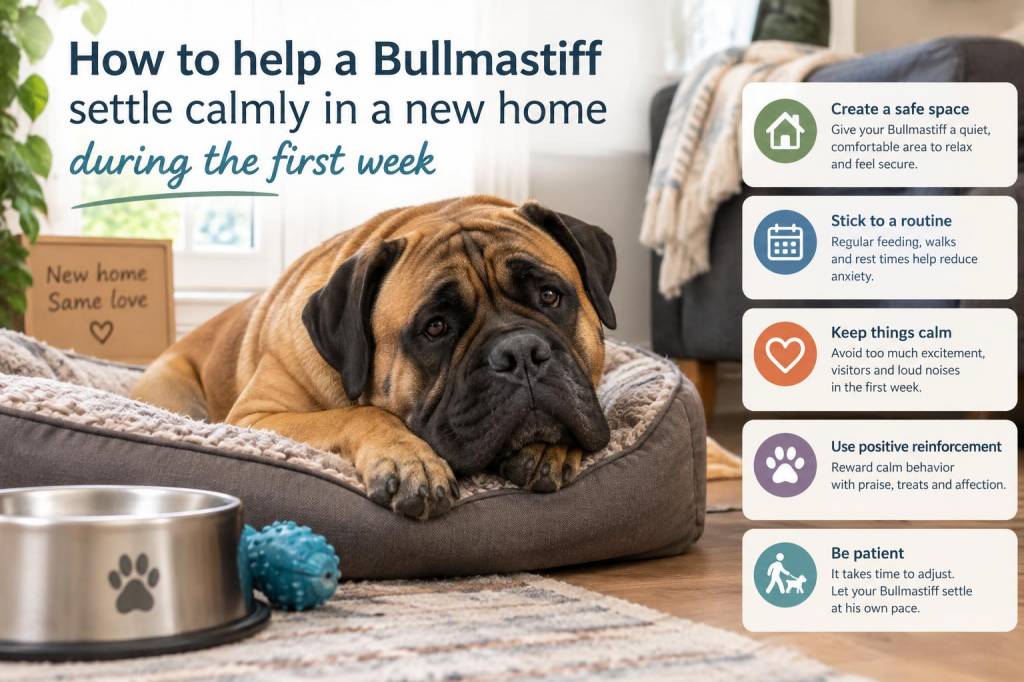
Bringing a Bullmastiff into a new home is always an emotional moment, and I never treat that first week lightly. Even a confident adult can feel overwhelmed by new smells, strange sounds, unfamiliar routines, and the sudden absence of everything they already understood. A Bullmastiff may look steady and unshaken from a distance, but I have seen enough of them to know that big dogs can carry big feelings quietly. My job in that first week is not to demand trust right away. My job is to make safety, structure, and calm easier to choose.
When I help a Bullmastiff settle, I start with a simple idea: less pressure creates faster confidence. A dog that is asked to meet everyone, explore everything, learn every rule, and behave perfectly all at once is likely to become tense or shut down. A dog that is given space, predictability, and gentle direction usually begins to relax sooner. I have used this approach with puppies, adult dogs, rescue dogs, and nervous rehomed Bullmastiffs, and it remains one of the most reliable ways to build a peaceful start.
Make arrival feel quiet and controlled
I always try to keep the arrival itself calm. I avoid large welcoming crowds, loud voices, and too much physical fuss. If possible, I bring the dog into the house with a leash on, walk straight to the chosen resting area, and let that space become the first safe place. For many Bullmastiffs, a calm first ten minutes matter more than a long first day. If children or visitors are excited, I ask them to wait until later. I want the dog to read the home as steady, not chaotic.
At this stage I also keep expectations very low. I do not worry about “showing” the dog the whole house. I choose a small area first, often a room with easy access to water, a bed, and a door to the garden or outside toilet area. That limited space helps prevent accidents, overstimulation, and wandering. A Bullmastiff is a large, powerful dog, but on day one I treat emotional security as more important than freedom.
Build a predictable routine from day one
Routine is one of the strongest calming tools I know. Bullmastiffs tend to feel safer when they can anticipate what comes next. During the first week, I keep meal times, toilet breaks, walks, rest periods, and bedtime as consistent as possible. I do not change the schedule every few hours just because it is convenient for people in the household. Stability helps the dog settle.
I also keep my own behavior consistent. I use the same cues, the same tone, and the same general order of events. If I want calm behavior, I must model calm behavior. A Bullmastiff notices whether I am rushing, hovering, or rewarding anxious energy. When I move slowly and speak plainly, I help the dog understand that nothing urgent is happening.
Use space, not constant attention
One mistake I see often is overwhelming a new dog with affection. Everyone wants to help, and everyone wants the dog to feel loved, but constant petting and attention can actually make a nervous Bullmastiff more unsettled. I prefer short, gentle interactions followed by quiet downtime. If the dog chooses to rest, I let that choice stand.
I also encourage family members to let the dog come to them. A Bullmastiff that approaches on its own is often telling you something important: “I am ready for contact.” That choice should be respected. I have found that dogs settle more quickly when they discover they do not need to perform for attention. They learn that calm behavior is enough.
Keep early training simple and rewarding
During the first week, I focus on very small wins. I do not start with complicated drills or long sessions. I work on name recognition, coming when called in easy situations, walking politely on leash inside or in the garden, and relaxing on a mat or bed. These are practical skills, but they are also emotional skills, because they teach the dog that good things happen when it remains settled.
My reinforcement style is straightforward: calm praise, food rewards, and brief success. Bullmastiffs usually respond well when training feels fair and understandable. I avoid corrections that create tension. If a dog is unsure, I lower the difficulty instead of forcing compliance. A confused Bullmastiff is not being stubborn; it is usually feeling overloaded.
Support rest as much as activity
Many people underestimate how tiring a new environment can be. Even if a Bullmastiff does not run around much, the mental work of processing a new home is exhausting. I make rest a priority. I give the dog a comfortable bed in a quiet area, and I protect that resting place from too much traffic. I do not allow repeated interruptions just because people want to see the dog sleeping.
In the first week I often notice that a Bullmastiff alternates between bursts of curiosity and long naps. I welcome that pattern. It shows the dog is beginning to absorb the environment. If a dog seems restless at night, I review daytime stimulation, feeding times, bathroom access, and whether the household is still too noisy in the evening. A calmer day usually leads to a calmer night.
Watch body language closely
Settling is not only about obedience. It is about emotional state. I pay close attention to posture, breathing, ear position, mouth tension, and willingness to move around the home. A Bullmastiff that is blinking slowly, stretching out, taking food easily, and exploring with a loose body is likely starting to relax. A dog that remains stiff, refuses treats, freezes in doorways, or watches everything without settling may need more space and slower introductions.
Here is a simple way I read early signals:
| Body signal | What I usually do |
| Loose body, soft eyes, normal breathing | Maintain routine and offer gentle praise |
| Hesitation at doors or stairs | Slow down, use leash support, reduce pressure |
| Refusing food or pacing | Lower stimulation, shorten interactions, review environment |
| Clinging to one person only | Allow attachment, then gradually broaden trust |
| Sudden barking or scanning | Remove triggers, create distance, return to calm exercise |
Introduce new people and spaces slowly
I never rush introductions during that first week. If a Bullmastiff is expected to meet visitors, children, other dogs, or busy public areas too soon, I usually hold off. I want the dog to settle into my home before I ask it to process a wider world. Even a friendly Bullmastiff can become jumpy or reactive if everything arrives at once.
When I do introduce something new, I keep it brief and controlled. One person at a time. One short walk at a time. One new room at a time. I prefer to end each experience on a positive, quiet note rather than wait until the dog is exhausted. That helps the dog build confidence instead of dread.
Manage feeding and bathroom habits with care
Food and toilet routines play a larger role than many people expect. I keep meals consistent and avoid major diet changes unless a veterinarian has advised them. A stressed Bullmastiff can have digestive upset, and I want to reduce any extra discomfort. Fresh water must always be available, and I monitor eating patterns closely. A temporary drop in appetite can happen, but I still watch for signs that something is wrong.
Bathroom habits deserve equal attention. I take the dog out regularly, especially after waking, after meals, and after active play. I do not punish accidents. Instead, I treat them as information. New homes can be confusing, and a large dog may not yet understand where it is expected to relieve itself. Calm consistency works far better than frustration.
Give confidence through small choices
One thing I love about working with Bullmastiffs is that they often bloom when they are given simple opportunities to make good decisions. I let the dog choose which side of me to walk on sometimes. I let it decide whether to lie on a bed or mat after being invited there. I let it sniff at its own pace instead of dragging it from one thing to another. These small choices do not create chaos; they create trust.
If I had to name one emotional goal for the first week, it would be this: I want the Bullmastiff to feel that life in this home is understandable. Not perfect. Not exciting every minute. Just understandable. That sense of clarity is often what allows a large, sensitive dog to relax fully.
What I avoid during the first week
- I avoid loud celebrations around the dog.
- I avoid too many visitors in a short time.
- I avoid changing rules from person to person.
- I avoid forcing greetings with other dogs.
- I avoid long walks that leave the dog overstimulated.
- I avoid punishment for fear, hesitation, or accidents.
- I avoid leaving the dog to cope with constant activity.
These limits are not about being strict for their own sake. They are about creating a home where a Bullmastiff can learn without feeling cornered. In my experience, calm confidence grows faster when I remove avoidable stress instead of trying to overpower it.
Notice when a veterinary check is needed
Not every difficult first week is just emotional adjustment. Pain, illness, digestive upset, ear problems, or previous untreated issues can make settling much harder. If I see persistent refusal to eat, repeated vomiting, severe diarrhea, extreme lethargy, limping, unusual panting, or signs of pain, I contact a veterinarian. A dog cannot settle properly if it feels physically unwell, and I never assume behavior is purely behavioral when health might be involved.
I also pay close attention to rescue dogs or dogs coming from uncertain backgrounds. A Bullmastiff that has changed homes several times may need much more time, gentler handling, and a slower pace. In those cases, patience is not optional. It is part of the plan.
When I help a Bullmastiff through that first week, I try to remember that settling is a process of trust, not a test of obedience. Every quiet nap, every relaxed meal, every easy toilet break, and every moment of soft eye contact tells me I am moving in the right direction. A Bullmastiff that begins a new life with calm support usually shows, very quickly, that it is capable of deep loyalty, steady affection, and a surprisingly tender heart once it feels safe enough to show it.