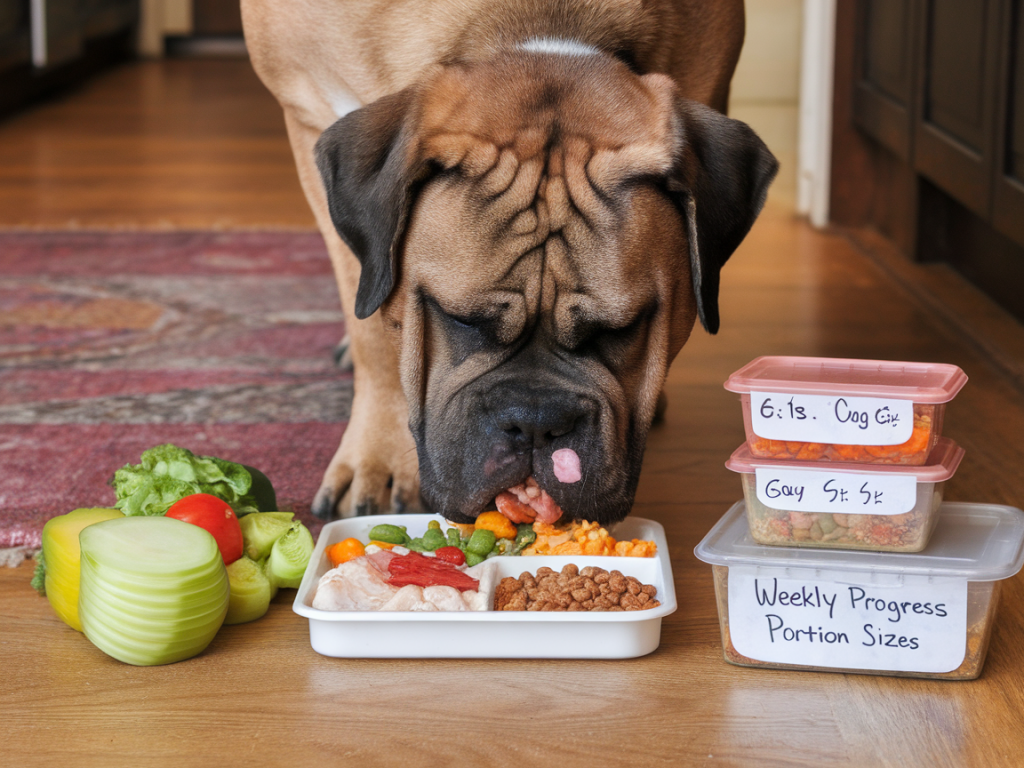
I remember the first time I had to put a Bullmastiff on a strict weight-loss plan: he was a gentle giant named Hugo, rescued after years of neglect. Watching him struggle to stand and slow down on short walks made me realise how critical a precise, calorie-based approach is. Over the years I've refined a method that balances safety, clear targets and real-life meal plans that owners can follow day by day. Below I share a calorie-by-calorie weight-loss plan you can adapt for your own Bullmastiff, sample meals and portions, and weekly progress targets to keep you on track.
Start with the numbers: calculate resting energy requirements
Before changing food or portions, you need reliable calorie targets. I always start with Resting Energy Requirement (RER) and then set a controlled deficit for weight loss.
RER = 70 x (body weight in kg)0.75. Practically, you can use the easier-to-calculate approximation for adult dogs:
- RER (kcal/day) ≈ 70 x (kg)^0.75 — or use an online calculator if you prefer.
For weight loss, aim for about 60–70% of the maintenance calories needed for the dog’s ideal weight (not current overweight weight). A safe, steady target is losing 1–2% of body weight per week. For many Bullmastiffs I work with I use about 60–65% of maintenance
Example calculation
Imagine a 60 kg Bullmastiff whose ideal weight is 50 kg (we always work from goal weight):
- RER (50 kg) = 70 x 500.75 ≈ 70 x 18.8 ≈ 1,316 kcal/day
- Maintenance for adult neutered medium/large breeds ≈ RER x 1.6 ≈ 2,105 kcal/day
- Weight-loss target (about 60% of maintenance) ≈ 0.60 x 2,105 ≈ 1,263 kcal/day
So we’d feed roughly 1,250 kcal/day to promote steady loss for that dog. If you prefer stricter loss, drop to 55% but only under veterinary guidance.
Sample meal plans and portions (approximate kcal)
I provide two styles: a high-quality dry diet plan and a mixed/meat-and-veg plan for owners who prepare meals at home. Portions are daily totals; split into 2 meals (or 3 for dogs who prefer it).
| Food | Amount | Calories |
|---|---|---|
| Royal Canin Weight Care dry (example) | ~370 g/day | ~1,250 kcal/day |
| Hill’s Science Diet Adult Light dry | ~420 g/day | ~1,250 kcal/day |
| Home-cooked mix: lean turkey, sweet potato, green beans | ~1,000 g combined (400 g turkey, 400 g sweet potato, 200 g green beans) | ~1,250 kcal/day |
| Low calorie wet topper (optional) | 1 can (~200 g) | ~150–200 kcal |
Notes:
- The dry food weights are examples; always check the kcal/kg on your bag. Royal Canin and Hill’s publish kcal values per cup or per 100 g.
- For home-cooked meals I weigh and calculate calories using food data (or an app like MyFitnessPal) and aim to meet the daily kcal total while including lean protein and fibrous veg to improve satiety.
Weekly progress targets and monitoring
Track weight weekly at the same time of day (I recommend mornings after a toilet break). Aim for:
- 1–2% weight loss per week — for a 50 kg target dog that’s 0.5–1 kg/week.
- If loss is <0.5% over 2–3 weeks, reduce daily calories by 5–10%.
- If loss is >3% in a week, increase calories slightly — losing too fast risks muscle loss and metabolic slowdown.
Keep a simple log: date, weight, daily calories fed, exercise minutes, body condition score (BCS). I use a BCS scale of 1–9; aim to move from overweight (6–8) towards 4–5 as the goal weight is approached.
Exercise and non-food strategies
Calories burned by activity help the deficit and preserve muscle. For older or joint-affected Bullmastiffs, low-impact exercise is key:
- Two 20–30 minute walks per day at a steady pace.
- Swimming is excellent if accessible — low impact and burns calories without stressing joints.
- Food-dispensing toys (Kong with low-calorie fillers like plain pumpkin or low-fat cottage cheese) increase activity and mental stimulation.
Remember to count treats as part of the daily calorie budget. If you give training treats, use sliced carrot, pieces of apple (no seeds), or commercial low-calorie treats such as Zuke’s Mini Naturals (~3 kcal each).
Supplements and nutrition considerations
Lean mass preservation is important, so ensure adequate high-quality protein. Many weight-specific diets are formulated to be higher in protein and fibre. Consider:
- Omega-3 supplements (fish oil) to support joint and skin health during weight loss — about 75–150 mg EPA+DHA per 10 kg body weight, but check with your vet.
- A multivitamin if you’re feeding home-cooked meals so micronutrient needs are met (brands like Nutri-Vet or Vet’s Best have options, but check formulations).
- Glucosamine/chondroitin for dogs with early joint issues — evidence is mixed but many owners report improvements; always discuss dose with your vet.
When to involve your vet and when to adjust
Always get a vet check before starting a weight-loss plan — rule out hypothyroidism, Cushing’s or other conditions that can cause weight gain. Re-check weight and body condition every 4–6 weeks with your vet. If weight loss stalls for more than 6–8 weeks despite strict adherence, we re-evaluate calorie calculations, medical causes, and activity levels.
One practical tip I use at Shadowguard: weigh the food with a kitchen scale rather than relying on cups. A 10–20% mis-measurement every day adds up quickly. Also, get the entire household on board — sneaky pocketing of treats by family members is the most common reason progress stalls.
If you'd like, I can create a tailored daily meal plan if you tell me your dog’s current weight, ideal weight, current food (brand/kcal per cup) and typical activity level — from there I’ll give exact portions and a 12-week progress chart you can print and follow.