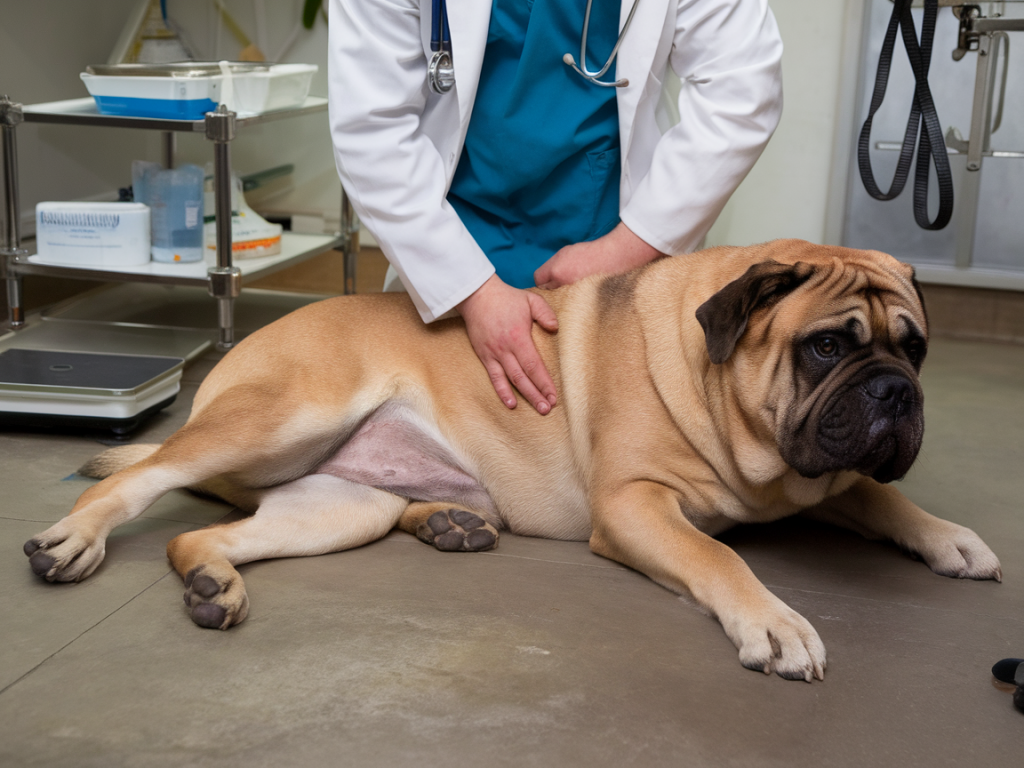
I often meet owners who are worried because their Bullmastiff has crept past a healthy weight. I’ve been there myself—one of my own dogs came back from a rehoming with a noticeable “softness” around the ribs and hips. Over the years I’ve developed a practical, step-by-step weight management approach that’s realistic for busy owners and kind to the dog. Below I share how I assess, plan and monitor a safe reduction in bodyweight, with concrete portion examples you can adapt to your dog and the food you use.
How I assess whether a Bullmastiff is overweight
The first thing I do is a simple physical check at home and then confirm with a vet. At home I look and feel for:
- Ribs: You should be able to feel the ribs under a light layer of fat with a gentle touch; they shouldn’t be buried under thick blubber.
- Waist: Seen from above, there should be an obvious tuck behind the ribcage; a round, continuous body means excess weight.
- Profile: From the side the belly should tuck up slightly rather than hang low.
Then I have the dog weighed by the vet and ask for a BCS (Body Condition Score). For Bullmastiffs I aim for a BCS of 4–5/9. If the vet confirms overweight, we discuss a target weight and any medical issues (hypothyroidism, orthopaedic problems) that might affect the plan.
Setting safe goals: how much and how fast
I recommend a safe, steady weight loss of about 1–2% of body weight per week. Faster losses can stress organs and increase the chance of muscle loss. For example, a 60 kg Bullmastiff losing 1% per week would lose 0.6 kg weekly — a comfortable pace that’s easier to sustain.
Work with your vet to set a realistic target weight. For many Bullmastiffs the target is between 45–55 kg depending on sex, frame and muscle mass. I always stress checking for underlying health problems first.
Calculating daily calories — my method
Once we have a target, I calculate a daily calorie goal. A simple method I use is:
- Estimate maintenance kcal for ideal weight: 70 x (ideal weight in kg)0.75 (this is the Resting Energy Requirement adjusted for a neutered/household dog by multiplying by 1.2–1.6 depending on activity).
- To lose weight safely reduce daily calories by about 10–20% from maintenance — I usually start at a 15% reduction and adjust based on progress.
Example: for a 50 kg ideal-weight Bullmastiff, RER = 70 × 500.75 ≈ 70 × 18.8 = 1,316 kcal. If I estimate a sedentary household multiplier of 1.4, maintenance ≈ 1,842 kcal. A 15% deficit gives a daily goal ≈ 1,566 kcal.
Always confirm calculations with your veterinarian before making changes.
Choosing the right food
I favour diets designed for weight control that retain high protein and moderate fibre — it helps preserve muscle while the dog loses fat and keeps them feeling satisfied. Prescription diets such as Hill’s Prescription Diet Metabolic, Royal Canin Satiety Support, or Purina Pro Plan Veterinary Diets OM can be useful under vet supervision. For general non-prescription options, look for adult formulas with:
- High-quality animal protein (helps preserve muscle)
- Moderate fat (so calories aren’t excessive)
- Moderate fibre (to increase satiety)
If you prefer homecooked or raw approaches, I insist on working with a veterinary nutritionist to ensure the diet is balanced while meeting calorie targets.
Portion examples (estimates you can adapt)
Below I provide examples based on an assumed kibble energy of 360 kcal per 100 g (this is an example figure — check your food packaging or manufacturer website for exact kcal/100 g or kcal/cup). These are starting points, not prescriptions. Adjust based on your dog’s response and vet advice.
| Current weight | Target weight | Daily kcal goal (approx) | Dry food (g/day @ 360 kcal/100g) | Wet food (g/day @ 120 kcal/100g) |
|---|---|---|---|---|
| 70 kg | 60 kg | 1,700 kcal | 472 g | 1,417 g |
| 65 kg | 55 kg | 1,600 kcal | 444 g | 1,333 g |
| 60 kg | 50 kg | 1,500 kcal | 417 g | 1,250 g |
| 55 kg | 47 kg | 1,400 kcal | 389 g | 1,167 g |
Notes: the wet food column assumes ~120 kcal/100 g. If your product has different kcal, update the calculations. I prefer weighing food on a kitchen scale rather than relying on scoops—precision matters with weight loss.
Treats, training and daily life
Treats derail many diets. I count every treat in the daily calories. My favourite low-calorie options:
- Small pieces of steamed carrot or green beans
- Commercial low-calorie training treats (for example, Zuke’s Mini Naturals or Lily’s Kitchen training treats)
- Use kibble from the daily ration as training rewards — that keeps calories in control
For enrichment, I use stuffed Kongs with a portion of the meal frozen inside, or puzzle feeders that slow eating and add mental stimulation without extra calories.
Exercise plan I use
Exercise helps maintain muscle and improve mobility — but with heavier dogs I increase activity gradually to protect joints. My approach:
- Start with short, controlled walks (10–15 minutes, 2–3 times daily) and increase duration by 5–10 minutes per week as the dog tolerates.
- Add low-impact activities like swimming or controlled lead-walking to build endurance without pounding the joints.
- Include strength-building games: slow hill walks, gentle tug sessions, and controlled sit/stand repetitions to preserve muscle.
Monitoring progress and adjusting
I weigh my dog every 2–4 weeks and track progress. If the dog isn’t losing at the planned rate after 4–6 weeks, I re-check calorie math, measure food again, reduce treats, or increase activity slightly. If weight is dropping too fast (>2% per week), I raise calories to avoid muscle loss.
Keep an eye on body condition, energy, coat quality and behaviour. If the dog becomes lethargic, loses appetite or shows other health changes, contact the vet immediately.
Real-life tip from my rescue work
When I rehabilitate overweight rescue Bullmastiffs I start with a gentle food-level change and lots of enrichment. Many arrive anxious and food-focused; sudden restriction increases stress. A slow, predictable routine (measured meals, enrichment toys, predictable walks) reduces anxiety and helps the dog adapt to a weight-loss plan. Positive reinforcement and patience win every time.
If you’d like, tell me your dog’s current and target weight plus the brand and kcal per cup (or per 100 g) of their food, and I can help you run through an example daily portion tailored to your dog.